
Atlanta, January 31, 2026
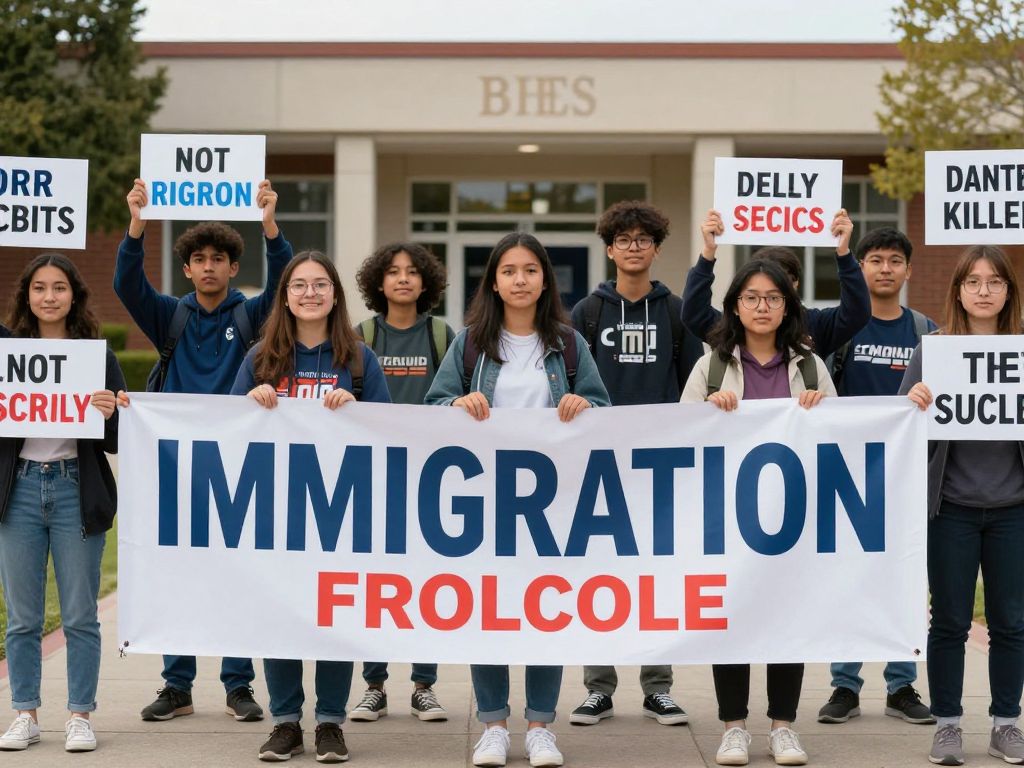
On January 30, students from over 100 schools in Georgia participated in organized walkouts to protest the actions of U.S. Immigration and Customs Enforcement (ICE). This significant movement, branded as a ‘National Shutdown,’ highlights deep concerns among students about immigration enforcement and its impact, particularly on Latino students who opted not to attend school due to fear. The protests reflect a growing civic awareness among youth and their desire to address critical issues affecting their communities.
Atlanta
On Friday, January 30, 2026, students from over 100 schools across the state of Georgia initiated organized walkouts in a significant display of collective action against the operations and policies of U.S. Immigration and Customs Enforcement (ICE). This widespread demonstration saw a temporary emptying of classrooms as young people across numerous districts chose to step out of their daily academic routines to voice their profound concerns. The actions taken by students in Georgia were understood by protest organizers to be a localized manifestation of a broader, synchronized initiative, which has been termed a “National Shutdown,” suggesting a coordinated effort stretching beyond state lines to address issues related to immigration enforcement.
The impetus for these student protests stemmed from deep-seated apprehensions within various segments of the academic community regarding the presence and activities of immigration enforcement. According to those who organized these walkouts, a distinct and palpable sense of fear, directly attributable to the perceived actions of ICE, regrettably led to a situation where some Latino students elected not to attend school on the day of the protest. This detail, quiet in its presentation, nonetheless speaks volumes about the human dimensions of public policy, illustrating how the reach of institutional mandates can extend into the very precincts of education and influence the daily choices and sense of security of individual students and their families.
The sheer scale of participation, encompassing well over a hundred educational institutions throughout Georgia, underscores a noteworthy degree of planning and a shared resolve among the student body. Such widespread engagement suggests that the issues at hand resonate deeply within these communities, prompting a collective response that transcends individual sentiment. These demonstrations, while momentary interruptions in the regular school day, are potent acts of civic expression. They represent a deliberate choice by students to momentarily set aside their textbooks and lessons, not out of idleness, but to illuminate matters they consider to be of fundamental importance to their lives and the lives of those around them. The collective act of walking out is, in itself, a form of eloquent testimony, a visible testament to convictions held and concerns that demand broader acknowledgment.
The context for these student-led actions is rooted in an ongoing national dialogue surrounding immigration policies and their multifaceted impacts on individuals, families, and communities. Student protests, even when focused on a specific governmental agency or set of regulations, frequently serve as sensitive indicators of wider societal currents. They offer a tangible glimpse into the evolving civic consciousness of younger generations, who are actively observing, interpreting, and responding to the complex social and political landscapes they inhabit. The act of students departing from their classrooms—spaces traditionally dedicated to quiet learning and intellectual growth—to engage in public protest is a time-honored method through which citizens, particularly youth, have historically articulated grievances, championed causes, and sought to catalyze change. It is a gesture imbued with a unique form of gravity, carrying a message that is both immediate and enduring.
Furthermore, the designation of these Georgia walkouts as part of a “National Shutdown” implies a sophisticated level of coordination and shared purpose that extends beyond regional boundaries. This interconnectedness suggests that the sentiments and specific concerns articulated by students in Georgia are not isolated instances but are echoed and amplified in other areas, pointing towards a common understanding of challenges related to immigration enforcement and a unified aspiration for a more reflective approach to these matters. The quiet, yet firm, determination displayed by these students offers a poignant opportunity for reflection on the profound human consequences of policy decisions—how legal frameworks are enacted, how they are enforced, and how, in turn, they undeniably shape lives, influence daily decisions, and, for some, evoke a profound and lingering sense of vulnerability. It serves as a gentle reminder that beyond the abstractions of policy debates lie the very real experiences of individuals whose daily existences are tangibly affected, and whose collective voices, often delivered with earnest simplicity, seek to convey a deeper human truth.
Frequently Asked Questions
- What was the primary reason for the student walkouts in Georgia?
- The primary reason for the student walkouts in Georgia was to express their dissent regarding the operations and policies of U.S. Immigration and Customs Enforcement (ICE).
- When did the student walkouts in Georgia occur?
- The student walkouts in Georgia occurred on Friday, January 30, 2026.
- How many schools in Georgia participated in the walkouts?
- Students from over 100 schools across the state of Georgia participated in organized walkouts.
- Were the Georgia student walkouts part of a larger movement?
- The actions taken by students in Georgia were understood by protest organizers to be a localized manifestation of a broader, synchronized initiative, which has been termed a “National Shutdown.”
- What impact did the protests have on some Latino students?
- According to those who organized these walkouts, a distinct and palpable sense of fear, directly attributable to the perceived actions of ICE, regrettably led to a situation where some Latino students elected not to attend school on the day of the protest.
Key Features of the Georgia Student Walkouts
| Feature | Detail | Scope |
|---|---|---|
| Event | Student Walkouts Against ICE | State-level (Georgia) with Nationwide context |
| Date | Friday, January 30, 2026 | State-level (Georgia) |
| Number of Schools Involved | Over 100 | State-level (Georgia) |
| Primary Protest Target | U.S. Immigration and Customs Enforcement (ICE) operations and policies | State-level (Georgia protest of Nationwide agency) |
| Broader Context | Part of a “National Shutdown” | Nationwide |
| Specific Impact Noted | Some Latino students stayed home out of fear related to ICE activities | State-level (Georgia, as reported by organizers) |
Deeper Dive: News & Info About This Topic
HERE Resources
Divergent Views on Immigration Enforcement Shape Georgia’s Senate Race
Metro Atlanta School Districts Warn Students of Walkout Consequences
Student Arrested After Gun Incident at Meadowcreek Elementary
Gun Violence in Georgia Schools Prompts Demand for Safety Measures

Author: STAFF HERE ATLANTA WRITER
The ATLANTA STAFF WRITER represents the experienced team at HEREAtlanta.com, your go-to source for actionable local news and information in Atlanta, Fulton County, and beyond. Specializing in "news you can use," we cover essential topics like product reviews for personal and business needs, local business directories, politics, real estate trends, neighborhood insights, and state news affecting the area—with deep expertise drawn from years of dedicated reporting and strong community input, including local press releases and business updates. We deliver top reporting on high-value events such as vibrant music festivals like Shaky Knees and Music Midtown, major cultural celebrations including Dragon Con and the Atlanta Film Festival, and iconic sporting events like the Peachtree Road Race. Our coverage extends to key organizations like the Metro Atlanta Chamber of Commerce and the Atlanta Convention & Visitors Bureau, plus leading businesses in logistics, beverages, and retail that power the local economy such as Delta Air Lines, The Coca-Cola Company, and The Home Depot. As part of the broader HERE network, including HEREAugusta.com and HERESavannah.com, we provide comprehensive, credible insights into Georgia's dynamic landscape.